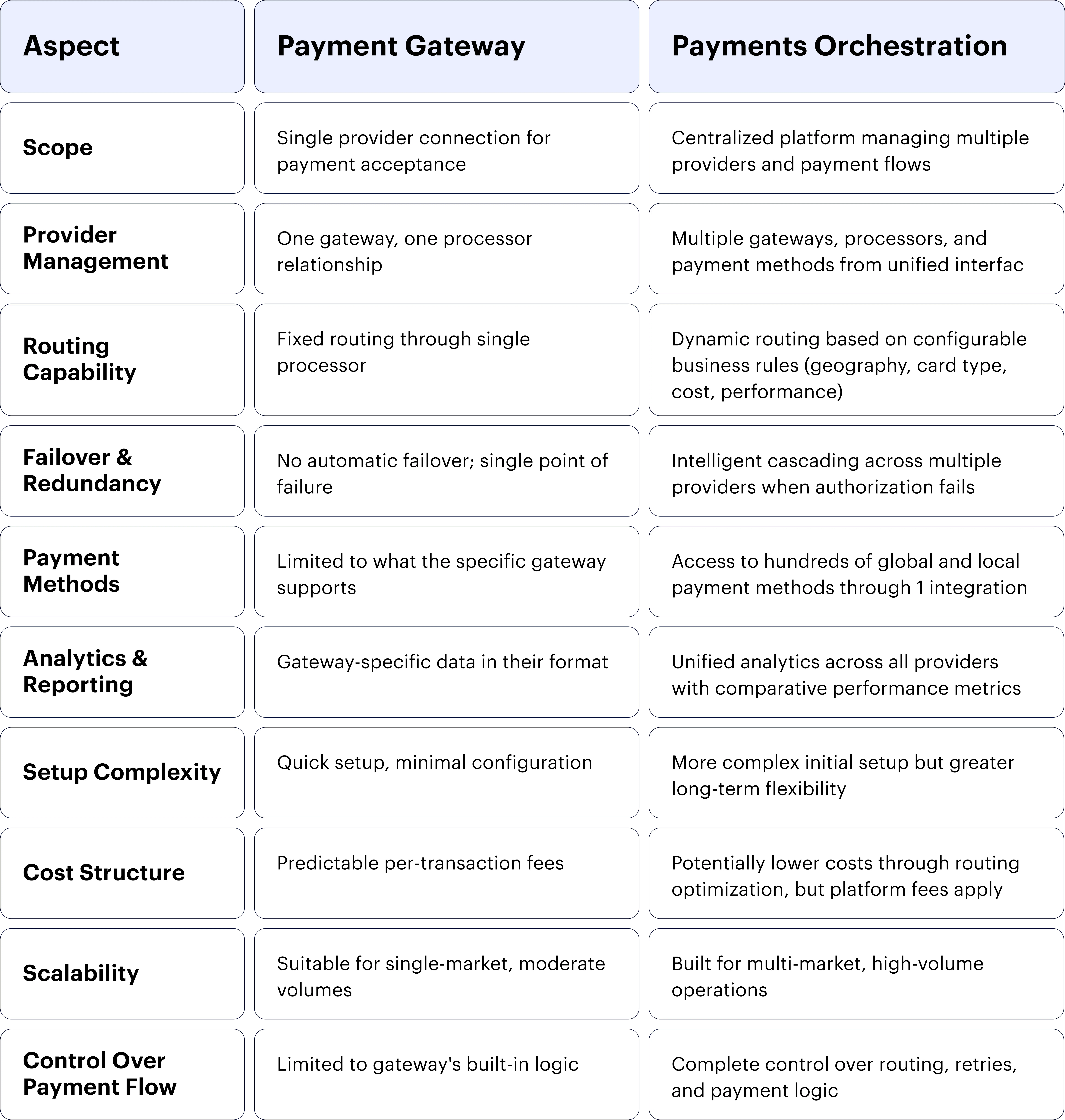
To understand payments orchestration meaning, think of it as a fundamentally different architectural approach to payment infrastructure management. Rather than connecting directly to a single payment processor, an orchestration platform sits as an intelligent layer between your business and multiple payment service providers, gateways, and alternative payment methods. It manages the complexity of working with numerous providers while giving you centralized control over payment routing logic, retry strategies, and payment flow management.
Think of orchestration as your payment operations command center. From one unified interface, you can connect dozens of payment providers, configure sophisticated routing rules that direct transactions to the most effective processor based on factors like card type, transaction amount, or customer location, and implement automatic payment failover when a provider experiences downtime. This architectural shift transforms payments from a fixed pipeline into a flexible, optimizable system.
The value proposition extends beyond redundancy. A payment orchestration or gateway platform comparison reveals that orchestration platforms provide unified payment analytics across all providers, enable A/B testing of different payment flows to improve checkout optimization, support rapid integration of new payment methods without engineering resources, and give you granular control over payment flow management. For businesses operating across multiple countries, managing multi-provider payments, or serving diverse customer segments with varying payment preferences, orchestration consolidates what would otherwise require managing separate integrations for each provider.
How payments orchestration works in practice
When a customer initiates payment through an orchestrated system, the platform first evaluates the transaction against your configured payment routing logic. These rules might prioritize a specific processor for transactions from European customers, route high-value transactions through a provider with better authorization rates for premium cards, or automatically split payment volume between processors to optimize interchange fees and improve payment performance.
If the first authorization attempt fails, the orchestration platform can immediately retry the transaction with an alternative provider without requiring the customer to re-enter payment information. This intelligent retry capability, called cascading, significantly improves authorization rates. Research shows that smart cascading can recover 10-15% of transactions that would otherwise fail, directly impacting revenue optimization without any change to the customer experience.
Beyond individual transaction optimization, orchestration platforms continuously collect performance data across all connected providers. You gain visibility into which processors have the highest authorization rates for specific transaction types, which alternative payment methods drive the most conversions in each market, and where transaction costs can be reduced through better routing. This data-driven approach to payment infrastructure management is simply impossible when working with isolated payment gateways.
When payments orchestration becomes critical
The transition from gateway to orchestration typically happens when businesses encounter specific pain points that single-gateway architectures can't solve. Payment orchestration for scaling becomes essential when you're expanding internationally and need to support local payment methods in each market – such as iDEAL in the Netherlands, Przelewy24 in Poland, or PIX in Brazil – orchestration enables you to add these methods through a single integration rather than building separate connections for each.
Companies processing significant transaction volumes face another critical trigger: authorization rates directly impacting revenue. When you're losing 2-3% of legitimate transactions to declines caused by processor-specific issues, temporary network problems, or suboptimal routing, that percentage represents substantial lost revenue. A payment orchestration or gateway platform that routes transactions intelligently and cascades to backup providers can recover most of these failed payments, often improving authorization rates by 5-10 percentage points.
For cross-border payments at scale, orchestration presents perhaps the strongest case. Managing separate payment gateways for each regional market creates operational complexity, fragmented reporting, and duplicated integration work every time you enter a new country. The global payment orchestration vs gateway comparison clearly favors orchestration for businesses operating across multiple markets, as platforms like Tranzzo's payment orchestration platform consolidate this complexity behind a single integration, letting you activate new markets, currencies, and payment methods through configuration rather than engineering sprints.




 Most Popular Payment Methods in the World: Analysis by Markets
 How to Increase Conversions in an Online Store with a Checkout Page
 How Tranzzo Simplified the Payment Process for Tickets.ua
 Integrating Multiple Payment Methods: Challenges and Solutions
 Abandoned Shopping Carts: Why Businesses Lose Revenue and How to Increase the Number of Successful Payments